





















































































































































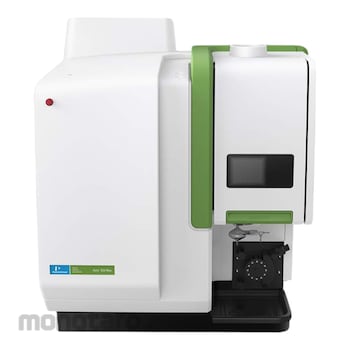

The Avio 550 and 560 Max are compact, fully simultaneous ICP-OES instruments, ideal for labs with high throughput requirements. They utilize a vertical plasma and are engineered to handle even the most difficult, high-matrix samples without dilution, delivering productivity, performance and faster return on investment. The instruments' performance is further optimized by Syngistix for ICP software, thanks to a host of smart features developed with the user in mind, providing smart workflows, smart monitoring and smart data.
Spectrometer Specifications
-Patented Optical Coatings: The Avio 550/560 Max spectrometers utilize a patented coating for all of the optics designed to increase light throughput throughout the UV region, resulting in superior detection limits for all sample matrices.
-Polychromator: The high-energy (f/6.7) echelle-based Avio 550/560 Max ICP-OES polychromator utilizes two SCD detectors simultaneously covering the spectral range from 163-782 nm. The measured resolution of the system is 0.006 nm at 200 nm. The 80 by 160 mm echelle grating has 79 lines/mm and a blaze angle of 63.4 degrees. The cross-disperser is a freeform optic for the UV region that has 374 lines/mm grating, while a 60-degree fused-quartz prism is added as the crossdisperser for the visible region.
The free-form UV cross-disperser within the Avio 550/560 Max spectrometer incorporates Schmidt correction to eliminate aberration (distortion) to produce sharp images at the detector, providing superior resolution across the spectrum, for the 400 mm radius camera sphere.
-Thermostatted Optics: The entire optical system is enclosed in a purged and thermostatted optical enclosure. The optical enclosure is mounted on the same optical bench as the sample-introduction system. The optical bench is shock-mounted to the frame of the instrument so that normal floor vibrations do
not affect system performance.
-Vertical Dual View Plasma: The system incorporates a vertically oriented plasma with complete dual-viewing optics under computer and software control. Any wavelength can be used (163-782 nm) in the radial, axial, or mixed viewing modes in a single method, providing maximum flexibility for the most difficult samples. With the dual view capabilities of the Avio 550/560 Max systems, viewing of the plasma is accomplished by computer control of a mirror located in the
optical path, allowing selection of axial or radial view and adjustment of the plasma viewing in both the vertical and
horizontal planes.
-Shutter and Hg Recalibration System: The computercontrolled, motor-driven shutter automatically opens and closes for each sample, protecting the transfer mirrors from long exposures to the intense UV radiation of the plasma, extending the lifetime of the mirrors. A mercury lamp is built into the shutter mechanism and can be viewed at a user-selected frequency to automatically update the system wavelength calibration at the 253 nm mercury emission line.
-Detectors: Two custom-designed, application-specific, fully simultaneous segmented-array charge-coupled device (SCD) UV and visible detectors consist of 235 addressable subarrays covering approximately 6000 wavelengths on a 13 by 19 mm silicon substrate. Typical readout noise is about 13 electrons RMS; dark current is less than 100 electrons/pixel/second; and readout speed is 50 μsec/pixel. Correlated double-sampling data-acquisition electronics further reduce electronic noise. SCD detectors are designed to prevent charge blooming on a pixel and have guard band protection on each subarray.
ICP System Specifications
-RF Generator: The Avio 550/560 Max ICP-OES instruments feature a fourth-generation 40-MHz, free-running solid-state RF generator, adjustable from 1000 to 1500 watts, in 1 watt increments. The power efficiency is greater than 79% with < 0.1% variation in output power stability. True power control maintains the plasma power at the set point, ±1 watt, even when changing sample matrices. The compact RF supply meets all FCC certification requirements for RF emission
(Part 18 of FCC rules and regulations).
-Plasma Source: The instruments' unique Flat Plate plasma technology is made of high-quality aluminum that does not require water cooling for safety and generates a transversely symmetrical, robust and matrix-tolerant plasma, with a typical total argon flow of 9 L/min, approximately half the consumption
of helical load-coil systems.
-Integrated Camera: PlasmaCam color camera allows real-time plasma and sample introduction viewing for easy method development, remote diagnostics and troubleshooting for maximum uptime.
-Plasma Ignition and Extinction: Plasma ignition is computercontrolled and totally automated. The software allows the plasma to be ignited automatically at a user-determined time and turned off automatically after an analysis.
-Safety Interlocks: For user safety and system protection, the system constantly monitors water flow, shear gas pressure, argon pressures, sample-compartment door closure, plasma stability and displays the interlock status on the computer screen as graphic symbols. If an interlock is interrupted, the plasma will immediately and safely shut down.
-Cooling Water: A water-recirculating cooling system is required, with approximately 4 L/min flow capacity at 310 to 550 kPa and a temperature between 15 °C and 25 °C.
Gas Flow Controls
-Argon Flow: Computer-controlled solenoid valves are used to regulate the flow automatically within the range of 0-17 L/min in 1 L/min increments for plasma argon and 0-2.0 L/min in 0.1 L/min increments for auxiliary argon. A mass-flow controller is supplied with all systems for the nebulizer argon flow and is variable between 0 and 2.0 L/min in 0.01 L/min increments.
-Shear Gas: PlasmaShear is a compressed-air shear gas (18-28 L/min) that utilizes thin air-knife technology, providing a more cost-effective approach to removing the cooler plasma zone otherwise known as the plasma tail. Removal of the plasma tail from the optical path minimizes interferences and extends the dynamic range. Also, real-time elimination of non-vaporized complex sample matrices and carryover contamination prevent cone deposition with elemental particle deposits that would otherwise fall into the plasma and corrode the optics, resulting in improved signal stability and robustness.
Sample Introduction System
-Torch/Torch Mount: A unique, demountable vertical torch design using one-piece quartz tubing for plasma and auxiliary gas flow is supplied. The standard torch includes a 2.0-mm i.d. alumina injector for full corrosion resistance to all acids, including hydrofluoric and aqua regia. A variety of other injectors are available. The externally mounted spray chamber is integrated into an easily removable sampleintroduction cassette. The sample-introduction cassette can be adjusted (with the plasma on) for maximum performance in different matrices. No tools are required for torch or sample-introduction cassette removal.
-Spray Chambers: Instruments can be ordered with a Ryton HF-resistant Scott-type or a glass cyclonic spray chamber.
-Nebulizers: The Avio 550/560 Max ICP-OES can be ordered with a cross-flow or glass concentric nebulizer. The cross-flow design with GemTips is HF and corrosion-resistant (sapphire/ruby tips in a PEEK body). The system can routinely handle 50% (v/v) solutions of HCl, HNO3, H2SO4, H3PO4, 20% (v/v) HF and 30% (w/v) NaOH. Additional nebulizers are available.
-Peristaltic Pump: The integrated four-channel, computer-controlled pump has variable speeds from 0.2 to 7 mL/min in 0.1 mL/min increments, using 0.76 mm (0.030 in.) i.d. tubing. Syngistix software, designed with the user in mind, offers many smart features to make your analysis easier and more accurate. Some of these features specific to the peristaltic pump include FastPump and SmartRinse, which dramatically improve the sample rinse-out and analysis times, and
Tubing Saver, which increases the longevity of the tubing by slowly cycling the pump back and forth when the system is turned on but not in use.
-Spares Kit: A spares kit of common replacement items is included.
Physical Data – Instrument
Environmental: The instrument will operate with a laboratory temperature between 15 and 35 °C (59-95 °F). For optimum instrument performance, the room temperature should be controlled at 20 ±2 °C.
PerkinElmer Inductively Coupled Plasma AVIO 550 MAX ICP-OES 1unit
Rp3.399.999.900
Persediaan
Spesifikasi Produk
| Model Number | AVIO 550 MAX |
|---|---|
| Unit | 1unit |
| Dimensions (WxHxD) (cm) | 76x87x84 |
| Power | One 200-230 VAC, 20A line, 2800 VA, Single-Phase, 50/60 Hz (±1%) |
| Berat (Kg) | 163.0 |
| Tanggal Produk Terdaftar | 20 September 2024 |
| Terakhir Diperbaharui | 27 May 2025 |
Informasi Produk
Description
Warning
Please contact first for detailled stockKetentuan dan Kondisi Barang
COD Tidak Berlaku
Pembayaran COD tidak tersedia untuk produk ini. Lihat selengkapnya
Pengembalian Barang 14 hari
Berubah pikiran tidak dapat diterima. Lihat selengkapnya
GRATIS ONGKIR* ke Jabodetabek, Banten,
Jabar & Jatim dengan minimum total pesanan Rp200.000 saat checkout. Lihat selengkapnya
Jabar & Jatim dengan minimum total pesanan Rp200.000 saat checkout. Lihat selengkapnya
Pilih jenis produk yang diinginkan
| Nomor SKU | Model Number | Masa Persiapan Barang | Harga | Jumlah |
|---|---|---|---|---|
| Loading... | ||||
Ulasan Produk

Tidak ada ulasan


 Buka WhatsApp